

English
English
Department Vision
To nurture 21st Century leaders who are effective communicators with a passion for the English Language.
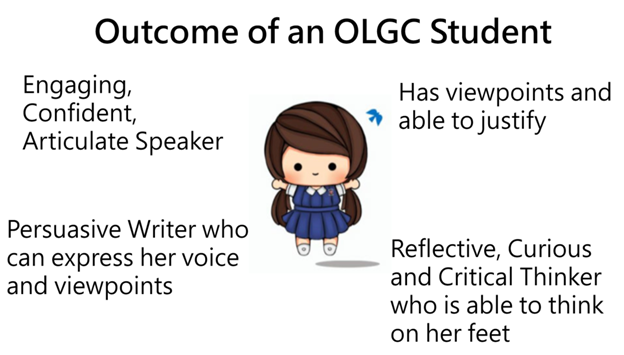
Our Philosophy: Nurturing Future-Ready Communicators
At the heart of our English curriculum is the commitment to developing our students who are not only literate across the literacy skills of reading, writing, speaking and listening, but also students who are articulate, empathetic, and critically aware of the world around them. Our approach integrates the national STELLAR 2.0 framework with school-specific innovations to create a dynamic learning environment.
The Four Pillars of Our Approach
1.Engaging Pedagogy:
With the pedagogical emphasis on Multiliteracies, Metacognition, and Inquiry through Dialogue in the EL classroom, our teachers enact STELLAR 2.0 to make literacy development an exciting journey–where learning is contextualised, learner-centred and one in which receptive and productive literacy skills are scaffolded, process-oriented and spiral in progression.
2.Fostering Future-Ready Confident Communicators:
From public speaking to media literacy to critical investigation of current affairs, we equip our students with skills to navigate a complex, digital, and globalised world.
3.Differentiated Learning, Inclusivity and Support:
Through Supplementary, Remedial and Learning Clinics, we ensure every child—regardless of their starting point—finds success. This structured scaffold allows our students to receive the support needed to strengthen their literacy skills.
4.Leadership and Excellence:
We provide platforms for students to shine, from internal storytelling competitions and national writing competitions to the Reading Sisters programme where our older girls accompany the younger ones on their reading progress.
Our Curriculum
The Core: STELLAR 2.0 National Curriculum
STELLAR 2.0 (Strategies for English Language Learning and Reading) is provides our foundational framework. It moves beyond rote learning to fostering a deep, authentic mastery of the English language.
- Lower Primary (P1–P3a): Focuses on experiential learning, using shared stories to build a strong foundation in grammar and vocabulary.
- Upper Primary (P3b–P6): Shifts toward collaborative learning, where students engage with complex texts and develop advanced comprehension skills.
School-Based Curriculum and Programmes
To complement the national curriculum, we have designed bespoke packages that address the specific needs and talents of our students.
i) D’LitE Fortnight, Reading Circles and Explorations and Inquiry
- With our Applied Learning Programme (ALP) in Drama and Literary Arts, our students are engaged in drama productions, creative writing and literary appreciation programmes such as reading and writing workshops, Readers’ Theatre and Reading Circles at P4 and P5.
ii) WOW! Writing, Journal Writing and Production of Class Newsletters
- We equip our students with techniques in writing to guide and nurture them to be expressive, confident, and intentional writers.
- As part of the post-PSLE activity,our students design and produce their very own class newsletter, giving them an insight into the publishing world.
iii) Cultivating a Reading Culture
- As an extension to the Extensive Reading Programme (ERP), we have analysed the books in the ERP, aligning them with STELLAR 2.0 units and have introduced a “Genre in Focus” for each term.
- Subscription to What’s Up, a value-added educational publication which supports literacy, current affairs awareness, and interdisciplinary learning across the school curriculum through specially curated age-appropriate news, features, and activities that promote critical thinking, vocabulary development, and real-world awareness.
- The Reading Sisters Programme provides a touchpoint for our older students to interact with the younger ones over books. This Programme hones our students’ leadership skills, and for the younger ones, they have a positive role model in the realm of reading to emulate and look up to.
- Author Spotlights allow our students the opportunity to meet-and-greet our local authors, inspiring our next generation of writers.
iv)Outreach: Literacy Beyond the Classroom
Learning in OLGC extends far beyond the four walls of the classroom. Our outreach programmes encourage students to apply their skills in authentic, real-world settings.
- Learning Journeys: Whether it is recount writing from their learning journey to the Zoo or being enraptured by interesting science facts at the Science Centre, then talking and writing about what they had learnt, our students see English as a tool for exploration and communication.
- Community Engagement: Through assembly showcases and walks around the school, our students learn to observe, describe, and interact with the world around them.
- National Platforms: We actively encourage participation in external speaking and writing competitions such as PESA and Commonwealth Writing Competition to build grit and confidence.
Importantly, we partner our parents in the following areas:
i) Being Active Listeners:
- to be attentive to how your daughter express herself
- to ask 5W1H questions to encourage your daughter to express her thoughts with intention
ii) Being Eloquent Speakers:
- to role model the speaking of standard English with good pronunciation and enunciation
- to encourage your daughter to express her thoughts and justify her viewpoints using standard English
- to encourage your daughter to think deeply and intentionally before speaking by asking “What makes you say that?” and “Could you elaborate on that?”
- by being discerning in media consumption by watching the news and/or listening to reputable podcasts and radio stations.
iii) Being Discerning Readers:
- by being good role models in reading for pleasure and for information
- by fostering a reading culture at home, including visits to the public libraries
iv) Being Skilled Writers:
- by creating authentic opportunities to write such as during the celebration of festive or family occasions
- by being good role models by writing gratitude notes or reflections to your daughter
- by encouraging your daughter to journal her thoughts and ideas using standard English
Recommended Reading List
https://www.nlb.gov.sg/main/site/discovereads/children/reading-recommendations/booklists
Recommended Online Dictionaries